How to Calculate T-Bill Interest: Treasury Bill Return Formula Explained
Learn how to calculate T-Bill interest, estimate Treasury bill returns, understand purchase price, maturity value, annualized yield, and when to use a calculator.
Treasury bills are simple, but the way they earn money can confuse new investors.
A T-Bill usually does not pay monthly interest like a savings account.
It usually does not pay coupon interest like a traditional bond.
Instead, a Treasury bill is typically sold at a discount and matures at full face value.
That means your return comes from the difference between:
- the price you pay
- the amount you receive at maturity
That difference is often what people mean when they talk about T-Bill interest.
If you are trying to estimate how much a Treasury bill could earn, you need to understand a few basic inputs:
- investment amount
- purchase price
- maturity value
- annualized yield
- days to maturity
- Treasury bill term
Want to skip the math?
Use the live calculator to estimate Treasury bill returns with current T-Bill data.
What Is T-Bill Interest?
T-Bill interest is the money you earn from holding a Treasury bill.
But unlike a savings account, a Treasury bill usually does not credit interest every month.
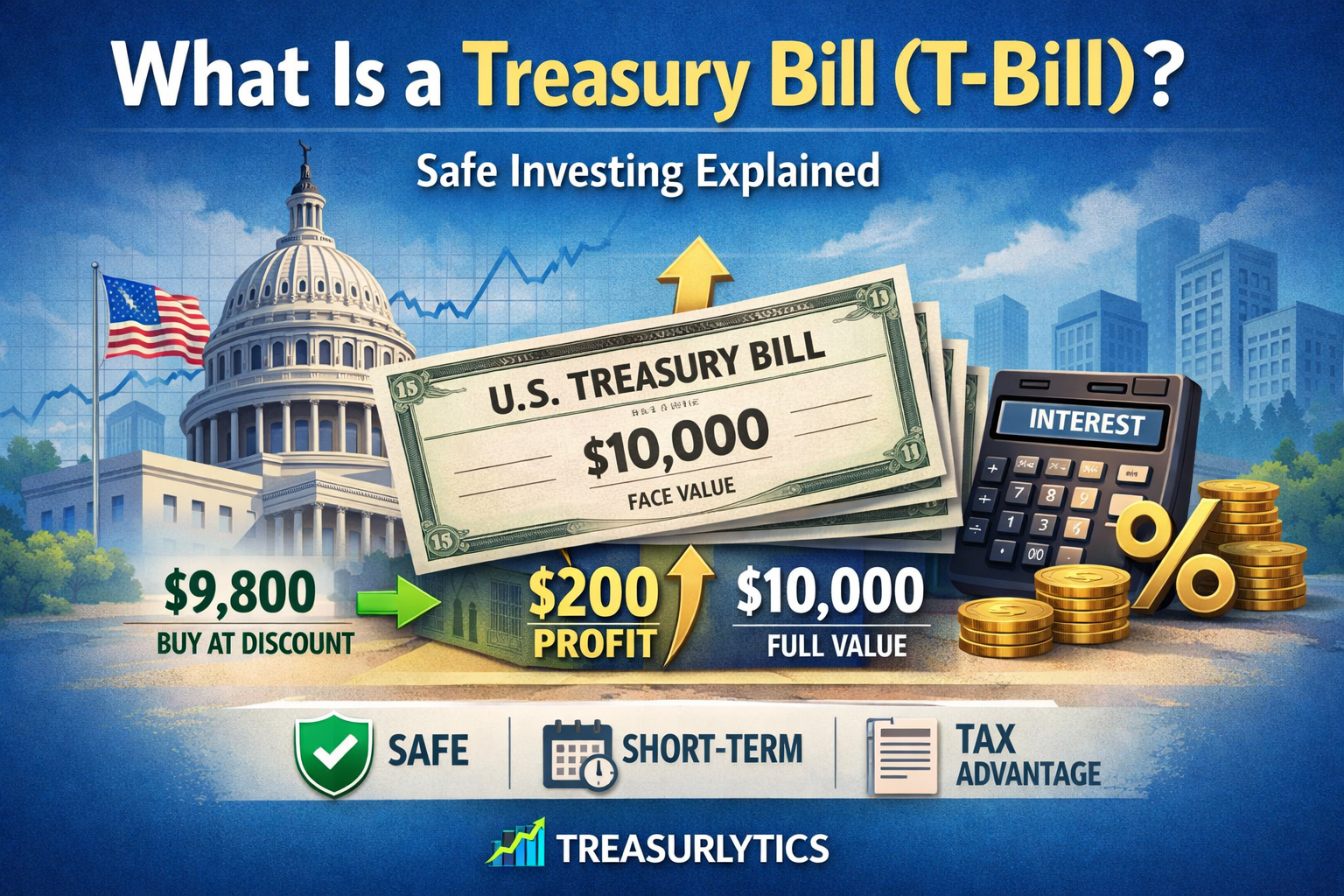
Instead, a T-Bill is commonly purchased for less than its face value and then redeemed at face value when it matures.
For example:
- You buy a T-Bill for $9,850
- It matures at $10,000
- Your estimated interest is $150
In this simplified example, the return is the difference between the maturity value and the purchase price.
T-Bill Interest = Maturity Value - Purchase Price
That is the basic idea.
The harder part is estimating the purchase price or understanding what the quoted yield means.
The Basic T-Bill Interest Formula
The simplest Treasury bill interest formula is:
Interest Earned = Maturity Value - Purchase Price
If you know the purchase price and the maturity value, the calculation is straightforward.
Example
Suppose you buy a Treasury bill that will pay $10,000 at maturity.
If your purchase price is $9,900, then:
Interest Earned = $10,000 - $9,900
Interest Earned = $100
Your estimated T-Bill interest is $100.
That is the cleanest version of the calculation.
But many investors start with a quoted yield, an investment amount, and a term. In that case, a calculator can help estimate the return.
Purchase Price vs Maturity Value
Two terms matter a lot when calculating T-Bill interest:
| Term | Meaning |
|---|---|
| Purchase Price | The amount you pay for the Treasury bill |
| Maturity Value | The amount you receive when the bill matures |
Treasury bills are usually sold at a discount.
That means the purchase price is usually below the maturity value.
The difference between the two is your estimated return if you hold the bill to maturity.
This is different from a savings account, where you usually deposit money and earn interest over time.
With a Treasury bill, the return is built into the discount.
Why T-Bills Are Sold at a Discount
Treasury bills are short-term government securities.
Instead of paying interest in regular installments, they are commonly issued at a price below face value.
When the bill matures, the investor receives the full face value.
That structure creates the return.
For example:
| Item | Amount |
|---|---|
| Purchase Price | $9,875 |
| Maturity Value | $10,000 |
| Estimated Interest | $125 |
The investor earns $125 if the bill is held to maturity.
The discount structure is one reason T-Bills are often used for short-term cash planning.
How Annualized Yield Fits Into the Calculation
When you look at T-Bill rates, the yield is often shown as an annualized percentage.
That helps compare Treasury bills with different maturities.
But a short-term T-Bill does not earn a full year of interest.
For example, a 4-week T-Bill with a quoted annualized yield is only held for about 28 days.
So the actual dollar return over that period will be much smaller than a full year of interest.
That is why investors should not only look at the annualized yield.
They should also look at:
- days to maturity
- investment amount
- maturity value
- expected interest earned
- whether the money can stay invested until maturity
See current annualized yields
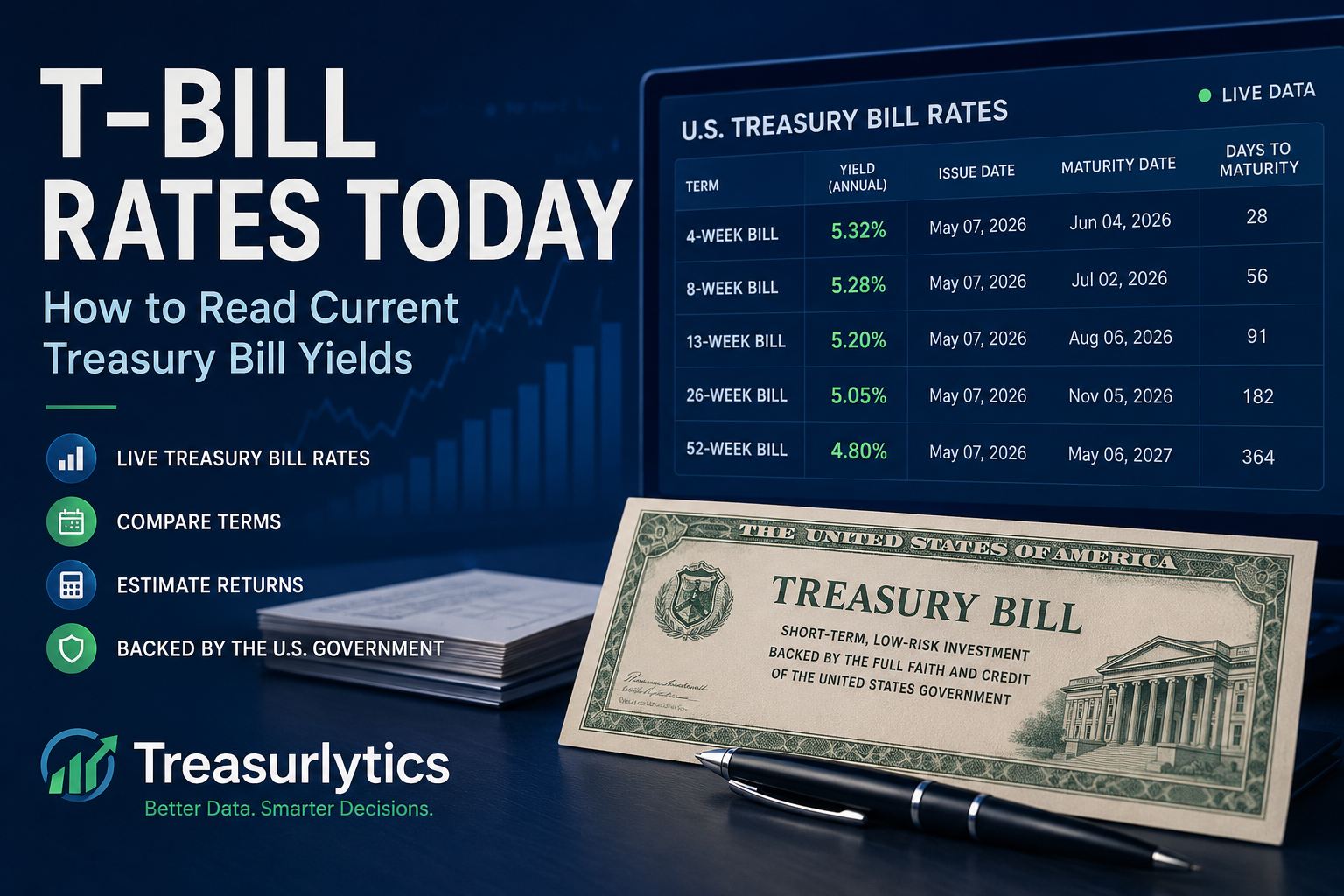
The live rates page lets you compare Treasury bills by term, yield, issue date, maturity date, days to maturity, and CUSIP.
Simple Estimated T-Bill Return Formula
A simplified way to estimate a Treasury bill return from annualized yield is:
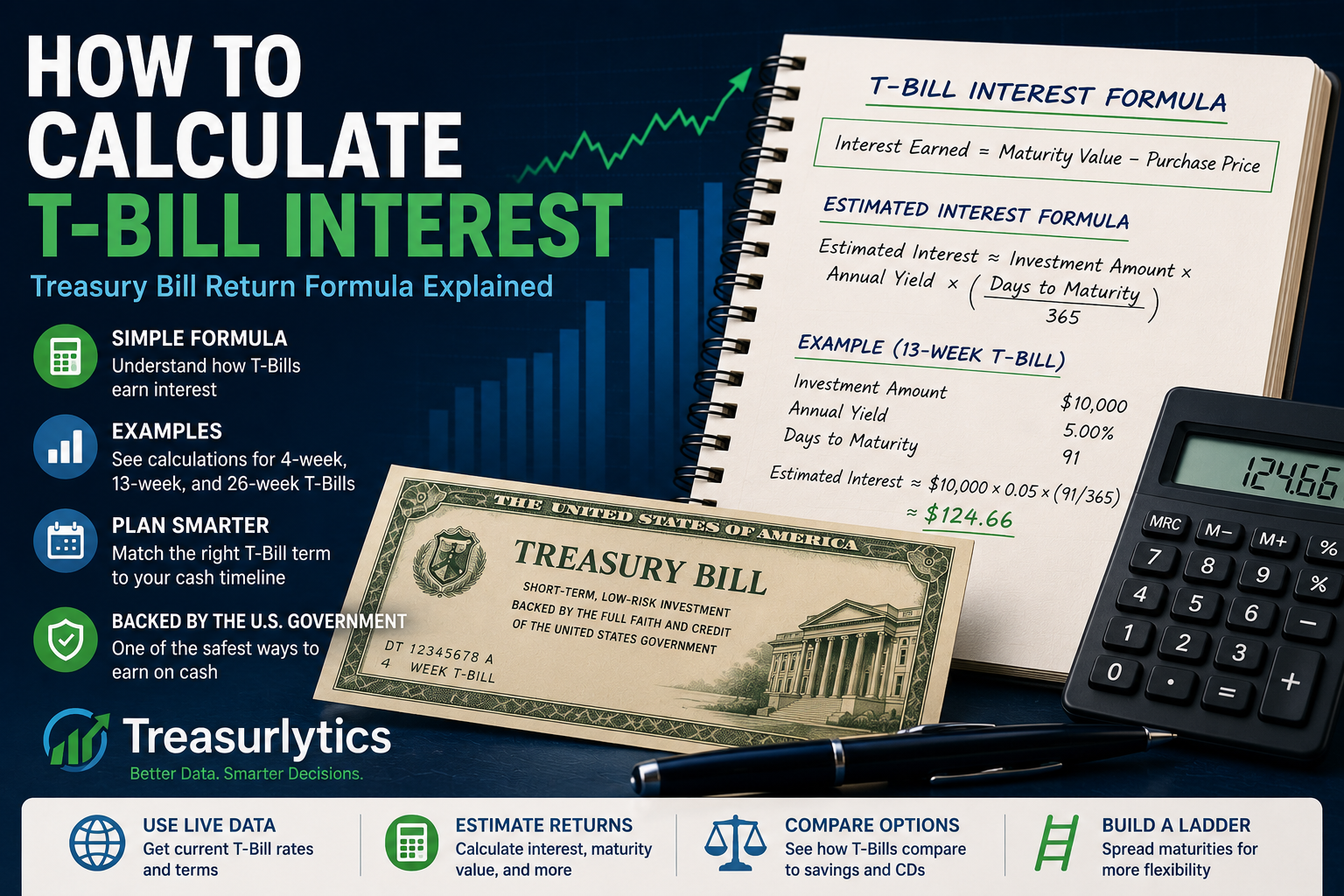
Estimated Interest ≈ Investment Amount × Annual Yield × (Days to Maturity / 365)
This is a simplified planning estimate.
It can help you understand the relationship between amount, yield, and time.
Example
Suppose:
- investment amount: $10,000
- annual yield: 5.00%
- days to maturity: 91 days
Then:
Estimated Interest ≈ $10,000 × 0.05 × (91 / 365)
Estimated Interest ≈ $124.66
This means the estimated interest over 91 days is about $124.66.
This is useful for planning, but actual Treasury bill pricing can differ depending on auction details, settlement timing, brokerage mechanics, and the exact yield convention used.
For a cleaner estimate using live inputs, use the calculator:
Example: Calculating Interest on a 4-Week T-Bill
A 4-week T-Bill is one of the shortest common Treasury bill terms.
It may be useful for cash you only want to set aside for about a month.
Suppose:
| Input | Value |
|---|---|
| Investment Amount | $10,000 |
| Annualized Yield | 5.00% |
| Days to Maturity | 28 |
Using the simplified formula:
Estimated Interest ≈ $10,000 × 0.05 × (28 / 365)
Estimated Interest ≈ $38.36
A 4-week T-Bill may not produce a large dollar return over one month, but it may still be useful for short-term cash that would otherwise sit idle.
The key question is whether the maturity fits your timeline.
Example: Calculating Interest on a 13-Week T-Bill
A 13-week T-Bill is roughly a 3-month Treasury bill.
Suppose:
| Input | Value |
|---|---|
| Investment Amount | $10,000 |
| Annualized Yield | 5.00% |
| Days to Maturity | 91 |
Using the simplified formula:
Estimated Interest ≈ $10,000 × 0.05 × (91 / 365)
Estimated Interest ≈ $124.66
The annualized yield is the same as the 4-week example, but the estimated interest is higher because the money is invested for more days.
This shows why time matters.
A longer bill can produce more total dollar interest, even if the annualized yield is similar.
Example: Calculating Interest on a 26-Week T-Bill
A 26-week T-Bill is roughly a 6-month Treasury bill.
Suppose:
| Input | Value |
|---|---|
| Investment Amount | $10,000 |
| Annualized Yield | 5.00% |
| Days to Maturity | 182 |
Using the simplified formula:
Estimated Interest ≈ $10,000 × 0.05 × (182 / 365)
Estimated Interest ≈ $249.32
The estimated dollar return is higher than the 4-week and 13-week examples because the investment period is longer.
But that does not automatically make the 26-week bill better.
You also need to ask:
- Can I leave the money invested for about six months?
- Will I need cash before maturity?
- Is the yield difference worth the reduced flexibility?
- Would a shorter Treasury ladder fit better?
Why Days to Maturity Matter
Days to maturity are critical when calculating T-Bill interest.
A quoted yield tells you the annualized return.
Days to maturity tell you how long that return applies.
For short-term Treasury bills, this difference matters a lot.
A 5% annualized yield over 28 days is not the same as earning 5% over a full year.
The shorter the bill, the smaller the total dollar return for the same investment amount and annualized yield.
That does not make short bills bad.
It just means they serve a different purpose.
Shorter T-Bills are often about liquidity and flexibility.
Longer T-Bills may produce more total interest but tie up cash longer.
T-Bill Interest vs Savings Account Interest
T-Bill interest and savings account interest work differently.
| Feature | Treasury Bills | Savings Accounts |
|---|---|---|
| How return is earned | Discount to face value | Interest credited over time |
| Access to cash | Best if held to maturity | Usually immediate |
| Rate certainty | Known for that bill if held to maturity | Can change anytime |
| Term | Fixed maturity date | No fixed maturity |
| Common use | Planned cash | Emergency cash and daily liquidity |
| State/local tax treatment | Generally exempt from state and local income tax | Usually taxable where applicable |
A savings account may be better for money you may need at any moment.
A Treasury bill may be better for money with a known timeline.
👉 Compare them side by side: Compare T-Bills vs Savings
T-Bill Interest vs APY
Many people compare T-Bill yields with savings account APY.
That comparison can be useful, but it is not always apples to apples.
A savings account APY usually describes the annualized return on money that remains in the account for a year, with compounding assumptions.
A Treasury bill yield is tied to a specific security with a specific maturity date.
When comparing T-Bills and savings accounts, consider:
- whether you need immediate access
- whether the rate is fixed or variable
- state and local tax treatment
- how long the money will remain invested
- whether the return is annualized or actual over the holding period
The headline rate is only the beginning.
The structure matters too.
What Inputs Do You Need to Calculate T-Bill Interest?
To estimate T-Bill interest, you usually need:
1. Investment amount
This is how much money you plan to put into the Treasury bill.
A larger investment amount produces more dollar interest, assuming the same yield and term.
2. Annualized yield
This is the quoted return measure used to compare Treasury bills.
3. Days to maturity
This tells you how long your money is expected to be invested.
4. Purchase price
If you know the purchase price, you can calculate the return directly.
5. Maturity value
This is the amount scheduled to be paid at maturity.
6. Term
This helps you understand the bill’s timeline, such as 4-week, 8-week, 13-week, 26-week, or 52-week.
The Treasurlytics calculator fills several of these fields automatically from live Treasury bill data.
Why Live T-Bill Data Helps
Static examples are useful for learning the formula.
But actual decisions should start with current data.
T-Bill yields can change as market conditions, Treasury auctions, and investor demand change.
A calculator that uses live Treasury bill data can help you estimate returns using currently available bill terms, yields, issue dates, maturity dates, days to maturity, CUSIPs, and price data.
That makes the estimate more useful than a generic example.
Use current data
Start with today’s available Treasury bill rates, then estimate the return for a specific amount and maturity.
Calculating Interest for Different T-Bill Terms
Different T-Bill terms can produce different results.
Common terms include:
- 4-week T-Bills
- 8-week T-Bills
- 13-week T-Bills
- 17-week T-Bills
- 26-week T-Bills
- 52-week T-Bills
A shorter bill may be useful when you want cash back soon.
A longer bill may be useful when you can leave cash invested for more time.
Here is the tradeoff:
| Term | Flexibility | Potential Total Interest |
|---|---|---|
| 4-week T-Bill | Higher | Lower |
| 8-week T-Bill | Higher | Lower to moderate |
| 13-week T-Bill | Moderate | Moderate |
| 26-week T-Bill | Lower | Higher |
| 52-week T-Bill | Lower | Higher |
This is a general planning framework, not a rule.
Actual yields and returns depend on the current Treasury bill data.
How to Use the T-Bill Calculator
The Treasurlytics T-Bill Calculator is designed to make this easier.
Instead of manually entering every field, you can:
- choose a live Treasury bill
- enter an investment amount
- review the yield, term, issue date, maturity date, CUSIP, and price
- calculate the estimated return
- email the result to yourself if you want to revisit it later
The calculator estimates:
- interest earned
- maturity value
- purchase price
- annualized return
👉 Try it here: Use the T-Bill Calculator
When the Formula Is Useful
The T-Bill interest formula is useful when you want to understand the mechanics.
It helps you see how the moving parts fit together:
- higher investment amount usually means more dollar interest
- higher yield usually means more estimated return
- more days to maturity usually means more total interest
- shorter maturities usually give you more flexibility
Even if you use a calculator, understanding the formula helps you interpret the result.
You do not have to become a bond trader.
You just need enough context to make a better cash decision.
When a Calculator Is Better Than Manual Math
Manual math can be useful for learning.
But a calculator is usually better when:
- you want to compare multiple T-Bill terms quickly
- you want to use current Treasury bill data
- you want to avoid mistakes with yield and day-count assumptions
- you want a quick estimate in dollars
- you want to email the result to yourself
- you are comparing T-Bills with savings accounts
For most visitors, the best workflow is:
- view live Treasury bill rates
- choose a bill that fits your timeline
- estimate the return
- compare it with other cash options
- decide whether the maturity fits your needs
Common Mistakes When Calculating T-Bill Interest
Mistake 1: Treating annualized yield as the actual short-term return
A 5% annualized yield does not mean a 4-week bill earns 5% over four weeks.
The yield is annualized for comparison.
Mistake 2: Ignoring the maturity date
A T-Bill is most predictable when held to maturity.
If you may need the money before maturity, the estimate may not match your real-world experience.
Mistake 3: Comparing only the highest yield
The highest yield may not fit your timeline.
A slightly lower-yielding bill with a better maturity date may be more useful.
Mistake 4: Forgetting taxes
Treasury securities are generally exempt from state and local income tax, but federal tax still applies.
After-tax comparisons may differ from headline yield comparisons.
Mistake 5: Ignoring reinvestment
When the bill matures, you need to decide what to do next.
If rates change, your next T-Bill may offer a different yield.
How T-Bill Interest Fits Into a Cash Strategy
T-Bill interest is not only about earning the most possible money.
It is about putting cash to work while keeping the timeline clear.
Treasury bills may fit money that is:
- not needed immediately
- tied to a known future date
- being held for taxes
- waiting for a planned purchase
- part of a conservative cash reserve
- being organized into a ladder
If you need all your cash at any moment, a savings account may be more practical.
If some cash has a clear timeline, Treasury bills may be worth comparing.
Using a Treasury Ladder
A Treasury ladder spreads cash across multiple maturities.
Instead of putting all your money into one T-Bill, you split it across several bills that mature at different times.
This can help balance:
- access to cash
- reinvestment flexibility
- yield opportunities
- maturity timing
For example, a ladder may use several short-term bills so that part of your cash becomes available every few weeks or months.
👉 Learn more here: How to Build a Treasury Ladder Build a Treasury Ladder
Frequently Asked Questions
How do you calculate T-Bill interest?
The simplest formula is:
T-Bill Interest = Maturity Value - Purchase Price
If you are estimating from annualized yield, a simplified planning formula is:
Estimated Interest ≈ Investment Amount × Annual Yield × (Days to Maturity / 365)
Actual results can vary depending on pricing, settlement timing, auction mechanics, and the exact yield convention used.
Do T-Bills pay interest monthly?
No.
Treasury bills usually do not pay monthly interest.
They are typically purchased at a discount and mature at face value.
What is the formula for Treasury bill return?
A simple return formula is:
Return = Maturity Value - Purchase Price
For planning estimates, investors often use investment amount, annualized yield, and days to maturity to estimate dollar interest.
How much interest does a 4-week T-Bill pay?
It depends on the current yield, investment amount, and number of days to maturity.
A 4-week T-Bill usually produces less total dollar interest than a longer bill with the same annualized yield because the holding period is shorter.
How much interest does a 26-week T-Bill pay?
It depends on the current yield, investment amount, and actual days to maturity.
A 26-week T-Bill usually produces more total dollar interest than a shorter bill with the same annualized yield because the money is invested for more days.
Is T-Bill interest better than savings interest?
It depends.
T-Bills may be attractive for planned cash that can stay invested until maturity.
Savings accounts are usually better for money that needs immediate access.
Does the T-Bill calculator use live data?
Yes. The Treasurlytics calculator loads available Treasury bill data so users can estimate returns based on current bill terms, yields, issue dates, maturity dates, and days to maturity.
Can I calculate T-Bill interest without knowing the purchase price?
You can estimate it using annualized yield, investment amount, and days to maturity.
However, if you know the actual purchase price and maturity value, the direct calculation is simpler.
Final Thought
T-Bill interest is easier to understand once you stop thinking about it like savings account interest.
A Treasury bill usually earns money through the discount between purchase price and maturity value.
That makes the basic idea simple:
Buy below face value, mature at face value, and keep the difference.
The practical decision is more nuanced.
You still need to compare terms, yields, maturity dates, liquidity needs, and alternatives.
That is why the best T-Bill decision usually starts with current rates and ends with a realistic estimate.
The formula helps you understand the mechanics.
The calculator helps you apply them to live Treasury bill data.
Next Step
Choose the next step based on what you are trying to do.
If you want to estimate T-Bill interest
Use the calculator to estimate interest earned, maturity value, purchase price, and annualized return.
If you want to check current T-Bill rates
Start with the live rates page to see current Treasury bill yields and compare terms.
If you want to compare T-Bills with savings
Compare Treasury bills against high-yield savings accounts using practical cash-management tradeoffs.
If you want recurring access to cash
Learn how a Treasury ladder can spread maturities over time.
How to Build a Treasury Ladder Build a Treasury Ladder
If you want to understand Treasury bills first
Read the beginner guide to Treasury bills.
If you want to understand today’s T-Bill yields
Read how to compare current Treasury bill rates and terms.